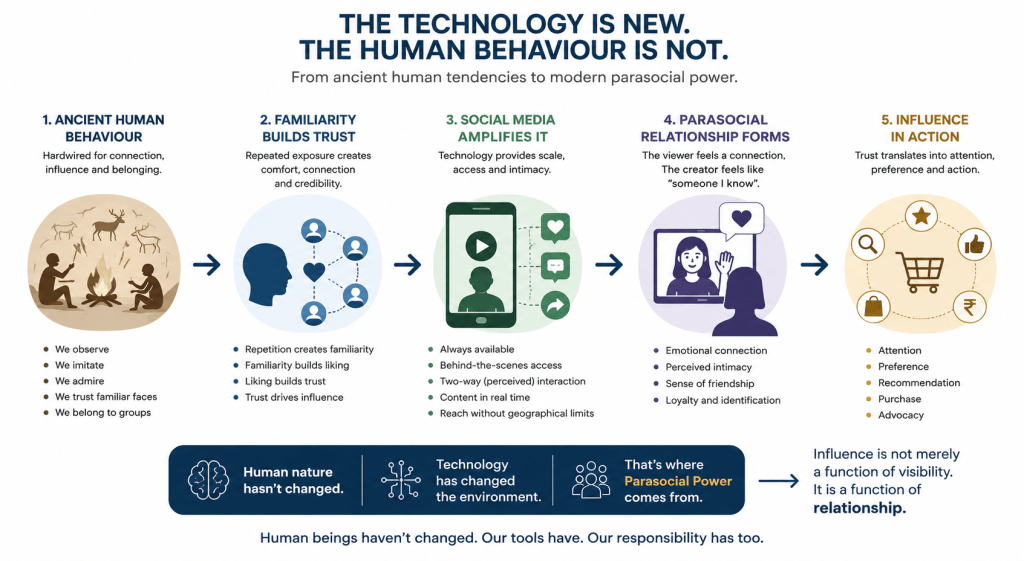
AI generated graphic
Why I believe understanding influencer marketing requires us to look beyond reach, engagement, and algorithms
Anthropology taught me something about influence that marketing sometimes forgets.
People do not make decisions in isolation.
We belong to groups. We observe others. We imitate people we admire. We trust some voices more than others. Our decisions are shaped not only by information but also by familiarity, emotion, identity and relationships.
None of this is particularly new.
What is new is the environment in which these very old human behaviours now operate.
Today, millions of people follow individuals they have never met. They watch them regularly, listen to their opinions, follow their lives and, in many cases, act on their recommendations.
A creator talks about a product, and people buy it. An influencer expresses an opinion, and thousands of followers respond to it. Sometimes, followers even come forward to defend a creator with the kind of emotion we might normally associate with defending someone we personally know.
Yet, in most cases, the creator and the follower have never met.
I find this fascinating, both as an anthropologist and as someone who spent nearly three decades studying consumers and human behaviour.
It also raises a question that eventually led me to write Parasocial Power:
Why do we allow people we have never met to influence what we think, desire and buy?
The Old Human Behaviour Behind a New Industry
Influencer marketing is usually discussed through numbers. Reach, followers, impressions, engagement, views, clicks, and conversions. All of these are important. Marketing needs measurement. But I sometimes wonder whether our ability to measure these things has also encouraged us to focus too heavily on what is easiest to count.
Consider two creators, each with one million followers. On a dashboard, they may appear similar. But are they equally influential? I don’t think we can assume that they are.
One audience may watch a creator because the content is entertaining. They enjoy it, perhaps engage occasionally, and move on.
Another audience may have followed a creator for years. They know the creator’s story. They know what he or she likes and dislikes. They have watched important events in the creator’s life. They may have seen the person at home, travelling, cooking, celebrating, complaining, or simply talking to the camera.
Over time, something interesting can happen. The follower begins to feel: “I know this person.”
The creator, of course, probably does not know the individual follower at all. This is the curious asymmetry at the heart of a parasocial relationship. The relationship is one-sided, but the sense of connection experienced by the audience can still be meaningful. And I believe that matters enormously when we try to understand influence.
From the Distant Celebrity to the Familiar Creator
Celebrity influence existed long before social media. Actors, sportspersons and other public figures have endorsed products for decades. But traditionally, celebrities were admired largely from a distance. You saw an actor in a film. You saw a cricketer on the field. Occasionally, you saw them in an interview or an advertisement. There was admiration, but there was also distance.
The creator economy has changed that distance. A social media creator can appear on your phone every day. You may watch that person while having your morning tea, travelling to work, or sitting at home in the evening.
This repeated exposure creates familiarity. And familiarity can gradually create something that is difficult to capture through conventional marketing metrics: perceived intimacy. The follower does not simply recognise the creator; then the follower may begin to feel connected to the creator.
That, in my view, is where the difference between visibility and influence becomes particularly interesting.
What Thirty Years of Research Taught Me
One of the lessons I learned from spending much of my professional life in market and social research is that people are not purely rational decision-makers. If we were, marketing would be considerably simpler.
Give people the correct information, demonstrate that one product is objectively better than another, and the decision should follow. But that is rarely how human beings behave. Our decisions are influenced by facts, certainly. But they are also influenced by emotion, familiarity, trust, identity, aspiration and social context.
Researchers often encounter another interesting gap: what people say they do and what they actually do are not always the same thing. That gap between stated behaviour and actual behaviour is one of the reasons I have always found consumer research fascinating.
The influencer economy adds another dimension to this. Now we have millions of consumers making choices in an environment where recommendation and relationship are becoming increasingly intertwined.
When a creator recommends a product, what exactly is creating the influence. Is it the quality of the argument, the usefulness of the information, the creator’s expertise, or is part of the persuasive power coming from something less visible, i.e. the trust accumulated through months or years of repeated exposure?
My suspicion is that it is often a combination of all these things. But conventional marketing metrics are much better at measuring the first few than the last.
Are We Measuring the Wrong Things?
I am not suggesting that marketers should stop measuring reach, engagement or conversions. Far from it. But perhaps these metrics tell us only part of the story. Reach tells us how far a message travelled. It does not necessarily tell us how deeply it mattered.
Engagement tells us that someone interacted with content. It does not automatically tell us why. Follower counts tell us the potential size of an audience. They tell us very little about the nature of the relationship between that audience and the creator.
This is why two creators with similar numbers can potentially produce very different outcomes for a brand. One has visibility. The other may have accumulated what I think of as relational capital of trust, familiarity and a sense of connection built over time.
The second is much harder to put on a dashboard. But it may ultimately be more important.
Looking at Influencer Marketing Through an Anthropological Lens
For me, influencer marketing is therefore not merely a new branch of digital marketing. It is also an interesting new chapter in a much older story about human beings.
Anthropologists have studied relationships, communities, status, belonging, imitation and social influence for generations. Social media has not invented these behaviours. It has changed their scale and their context.
A person sitting alone in a room can now develop a sense of connection with someone thousands of kilometres away. A creator can become part of the everyday routine of millions of strangers. And a relationship that exists almost entirely through a screen can influence very real decisions in the physical world.
That is remarkable. It is also why I believe we need to study the influencer economy not only through marketing analytics but also through psychology, sociology, and anthropology. Because behind every metric is still a human being.
The Question I Keep Coming Back To
While writing Parasocial Power, I kept returning to a fairly simple question: What kind of relationship exists between the creator and the audience?
I think this question deserves much more attention. We know how many people are watching.
Increasingly, we know how long they are watching. We know what they click and, in many cases, what they eventually buy. But we still know much less about the psychological relationship that sits between exposure and action.
Why does one creator’s recommendation feel like advertising, while another’s feels like advice from someone we trust? Why do some audiences remain passive while others become fiercely loyal communities? And why do we sometimes feel that we “know” people who do not know us at all?
These are marketing questions. But they are also questions about human behaviour. And perhaps that is the most interesting thing about the influencer economy.
The platforms are new. The algorithms are new. The scale is certainly new. The human tendencies underneath them are much older. We still observe, imitate, seek belonging, and trust people who become familiar to us. Technology has simply created a new environment in which all of this can happen between millions of people who may never meet.
For me, that is where the real study of influence begins.


Leave a Reply