Introducing a new framework for understanding influence in the digital age.
We Measure Almost Everything—Except What Actually Drives Action
The digital economy is obsessed with metrics. Followers, views, likes, comments, shares, watch time, click-through rates. Every platform promises another dashboard. Every marketer asks for another report. Every influencer celebrates another milestone.
Yet one uncomfortable question remains unanswered: Why do some messages with modest engagement change people’s behaviour, while others with millions of views disappear without leaving any lasting impression?
The answer, I believe, lies in something we rarely attempt to measure—not attention, but concern.
A person may watch a video. They may even like it. But unless the subject becomes personally meaningful, nothing changes. This gap between attention and action is where a new concept becomes useful.
I call it the Concernometer.
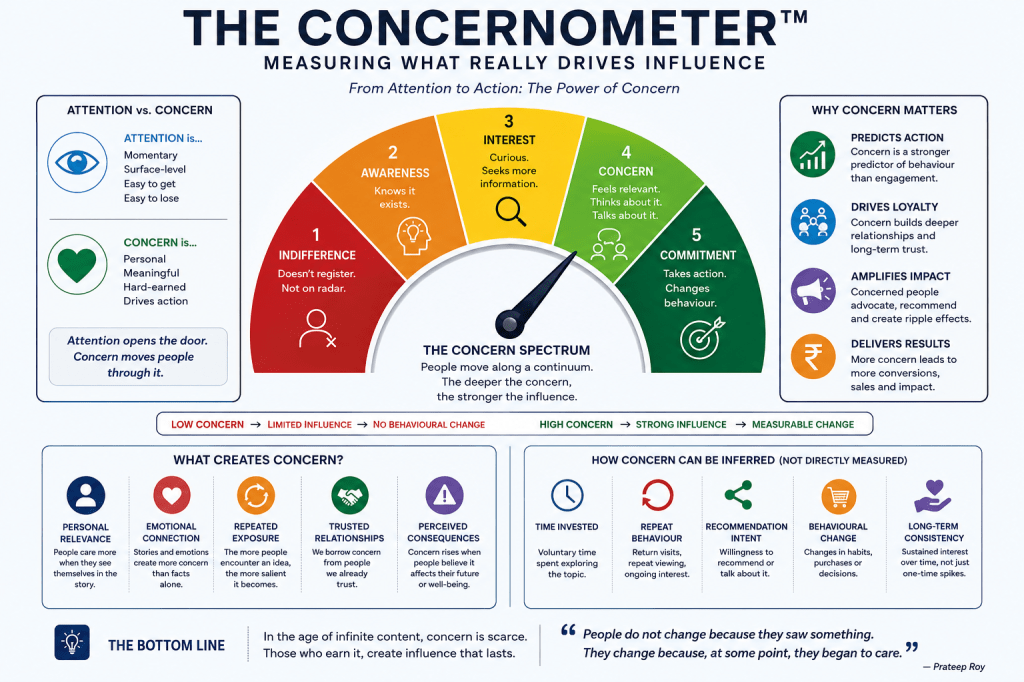
What Is a Concernometer?
A Concernometer is a conceptual framework that measures how much a person genuinely cares about an issue, person, or idea at a given point in time.
Unlike engagement metrics, which measure visible behaviour on platforms, the Concernometer measures an invisible psychological state.
It asks a different question. Not: “Did they engage?” But: “How deeply does this matter to them?”
Concern is what determines whether information remains just another piece of content—or becomes something capable of influencing decisions.
Attention Is Cheap. Concern Is Expensive.
Digital platforms have made attention abundant. Almost anyone can command attention for a few seconds. Concern is different. Concern requires investment. It demands emotional, psychological, or practical relevance.
Think about the difference.
You may watch a documentary about climate change. You may appreciate it. You may even recommend it. But unless climate change becomes personally significant, your daily behaviour may remain the same.
The same applies to finance. Thousands read articles about retirement planning. Only a few actually start investing. The difference isn’t knowledge. It’s concern.
Concern Is the Fuel Behind Human Behaviour
Behavioural science has repeatedly shown that people act when issues become personally relevant.
Health campaigns succeed not because people learn new facts, but because they begin to believe: “This could happen to me.”
Insurance is purchased not because policies are interesting. It is purchased because risk becomes personally meaningful. Parents change schools when they become concerned about education. Citizens vote when they become concerned about governance. Consumers switch brands when they become concerned about quality, price, sustainability, or trust.
Concern converts passive awareness into active behaviour.
Why Traditional Metrics Miss the Point
Imagine two creators. Creator A receives one million views. Creator B receives fifty thousand. Conventional wisdom declares Creator A more influential.
But suppose:
- Only 2% of Creator A’s audience genuinely cares.
- Nearly 70% of Creator B’s audience deeply identifies with the subject.
Who is more likely to shape opinions? Who is more likely to change purchasing decisions? Who will generate stronger word-of-mouth?
The answer becomes obvious. Influence depends less on audience size than on audience concern.
Yet today’s dashboards cannot distinguish between casual curiosity and genuine importance. Everything becomes another number.
Concern Exists on a Spectrum
Concern is not binary. People don’t simply care or not care. Instead, concern exists along a continuum. At one end is indifference. The issue barely enters consciousness. Next comes awareness.
People know something exists but feel little personal connection. Then comes interest, curiosity develops, and information is actively sought. Beyond interest lies concern.
Now the issue feels relevant. It occupies mental space. People discuss it, research it, think about it; finally comes commitment. Behaviour changes, money is spent, time is invested. Identity becomes linked to the issue.
The Concernometer attempts to locate individuals somewhere along this progression.
Parasocial Relationships Amplify Concern
This is where influencer marketing becomes especially interesting. Traditional advertising tries to generate concern quickly. Influencers often inherit concern through relationships. Followers already trust them. Their recommendations arrive wrapped inside familiarity.
A skincare recommendation from a stranger is information. The same recommendation from a creator you’ve followed every day for three years feels different. Not necessarily because the product changed. Because the relationship changed.
Parasocial relationships increase the likelihood that followers will care about what the influencer cares about. Concern spreads through trust.
Why Concern Predicts Better Than Engagement
Suppose an influencer uploads two videos.
Video One: 800,000 views, high entertainment value, and minimal behavioural change.
Video Two: 90,000 views, fewer likes, but thousands begin changing habits.
Traditional metrics celebrate Video One. Behavioural outcomes favour Video Two.
Why? Because Video Two generated greater concern. While engagement measures activity, concern measures importance. The distinction matters.
What Creates Concern? Concern rarely appears by accident. It develops through multiple psychological mechanisms.
Personal relevance: People care more when they see themselves reflected in a story.
Emotional connection: Stories outperform statistics because emotions assign importance.
Repeated exposure: Ideas encountered repeatedly become increasingly salient.
Trusted relationships: We borrow concern from people we already trust.
Perceived consequences: When people believe an issue affects their future, concern rises dramatically.
These mechanisms work together to move people along the concern spectrum.
The Strategic Value of the Concernometer
For marketers, the Concernometer shifts the central question. Instead of asking: “How many people reached?” We begin asking: “How many people genuinely cared?”
For researchers, it encourages measuring psychological engagement rather than platform engagement. For creators, it rewards depth instead of virality. For organisations, it helps explain why some campaigns with modest reach outperform campaigns with enormous visibility.
Concern becomes a leading indicator of behavioural change.
Can Concern Be Measured?
Not perfectly. At least not yet. Unlike likes or impressions, concern cannot be captured with a single dashboard. But it can be inferred.
Researchers might examine indicators such as:
- Time voluntarily spent exploring a topic.
- Repeat visits to related content.
- Willingness to recommend the issue to others.
- Behavioural changes after exposure.
- Donations, purchases, or advocacy.
- Long-term consistency rather than one-time engagement.
No single indicator is sufficient. Together, they offer a richer picture than likes alone.
The Concernometer is therefore best understood as a conceptual measurement framework, not a single numerical score. Its purpose is to redirect attention toward the psychological variables that actually shape behaviour.
Why This Matters in the AI Era
Artificial intelligence will make content creation faster, cheaper, and more abundant than ever before. The world will not suffer from a shortage of information. It will suffer from a shortage of meaningful attention.
As content becomes infinite, concern becomes increasingly scarce. Winning attention will become easier. Winning genuine concern will become harder.
Those who understand this distinction will build stronger brands, stronger communities, and more enduring influence.
A New Lens for Understanding Influence
The Concernometer is not merely another marketing metric. It is an attempt to rethink influence from a human perspective. People do not change because they saw something. They change because, at some point, they began to care.
Attention may open the door. Engagement may start the conversation. But concern is what moves people from observation to action. If we want to understand influence—not just measure it—we must begin measuring what matters most.
Perhaps the most valuable question we can ask is no longer: “How many people saw this?”
But rather: “How many people truly cared?”
That, ultimately, is what the Concernometer seeks to understand.
About the Concept:
Concernometer™ is an original conceptual framework developed by Prateep Roy to explain how personal concern mediates the relationship between attention and behavioural influence. It proposes that the intensity of concern—not merely visibility or engagement—is a stronger predictor of decision-making, trust, and action. This article is the first in an ongoing series exploring its theoretical foundations and practical applications.


Leave a Reply