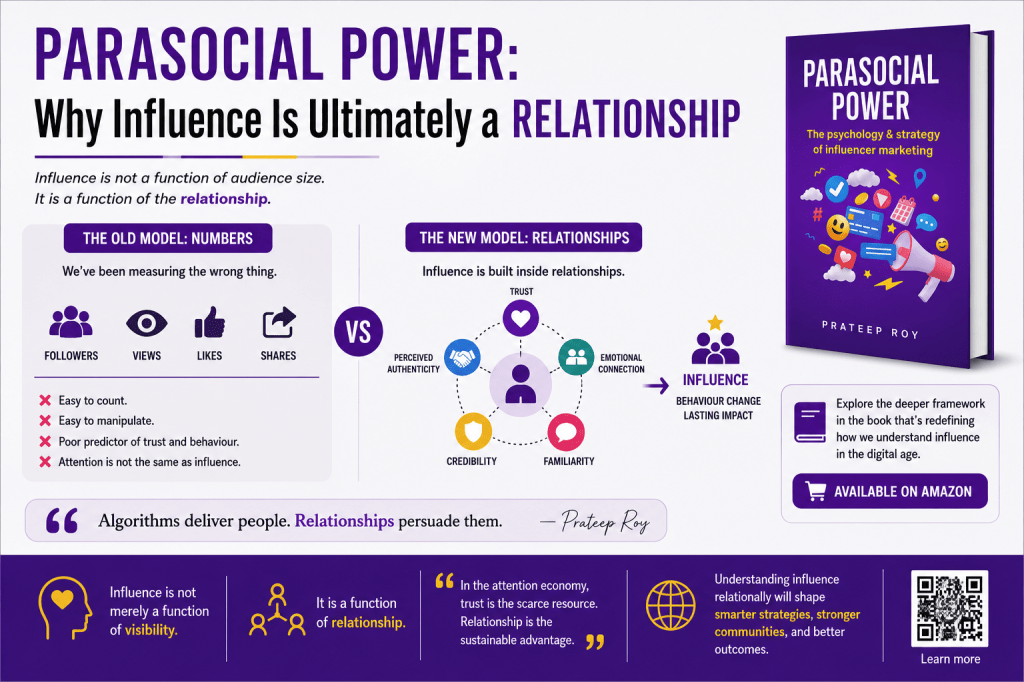
Graphic is AI-generated
For years, the digital world has measured influence with numbers: Followers, subscribers, views, likes, and shares. The larger the numbers, the greater the assumed influence.
Entire industries, from advertising to politics, have adopted this assumption. Marketing budgets are allocated based on audience size. Brands negotiate with creators using follower counts. Media rankings celebrate those who command the biggest digital audiences.
Yet something about this equation has never felt entirely satisfactory. Every one of us has seen creators with millions of followers struggle to sell products, while someone with a much smaller audience consistently inspires people to buy, donate, volunteer, vote, or change their behaviour.
If influence were merely a matter of numbers, these outcomes would be impossible. They are not exceptions. They reveal that we have been measuring the wrong thing.
The central argument of Parasocial Power is simple: Influence is fundamentally a relationship, not a statistic. Everything else follows from that idea.
The Problem with Counting People
Numbers are attractive because they are visible. Relationships are not.
A creator with five million followers appears influential because the audience can be counted instantly. Trust cannot; concern cannot; emotional closeness cannot; psychological attachment cannot.
These are invisible variables. Yet invisible variables often explain behaviour far better than visible ones. A teacher influences twenty students every year. A parent influences two children. A respected physician influences hundreds of patients.
None of them require millions of followers to create lasting behavioural change. The reason is obvious. Influence has never depended solely on exposure. It depends on the quality of the relationship between two people.
Digital media has not changed this principle. It has merely created new environments in which relationships develop.
The Ancient Psychology Behind Modern Platforms
Although influencer marketing appears to be a modern phenomenon, the psychology behind it is remarkably old. Human beings evolved in small communities where repeated exposure created familiarity. Familiarity gradually became trust. Trust encouraged cooperation. Cooperation increased survival.
Long before smartphones existed, repeated interaction was already shaping human behaviour. Today’s platforms simply compress and accelerate this process. A viewer may watch the same creator every morning while drinking coffee. Another listens to the same podcast during daily commutes. Someone else follows a LinkedIn writer for several years, reading hundreds of thoughtful posts. No conversation may ever occur.
Yet repeated exposure slowly creates psychological familiarity. The creator begins to occupy a place in the audience’s mental world. This is not friendship. But neither is it mere entertainment.
It is something in between.
Psychologists have long described these one-sided emotional bonds as parasocial relationships.
Why Relationships Matter More Than Reach
Consider two creators. The first has two million followers. The second has fifty thousand. If we measure influence numerically, the first creator should always outperform the second.
Reality often disagrees. The smaller creator may enjoy higher engagement, stronger audience trust, more meaningful conversations, greater credibility for recommendations, and higher conversion rates.
Why?
Because influence is generated inside relationships rather than inside algorithms. Algorithms distribute content. Relationships determine whether people care.
A recommendation from someone we trust carries far greater weight than one from someone we merely recognize. Recognition creates visibility. Relationships create persuasion. These are not identical.
The Missing Variable: Relational Capital
Businesses understand financial capital. Economists discuss social capital. Brands invest in brand equity. Yet influencer marketing lacks an equally useful concept for describing accumulated trust between creators and audiences.
I call this Relational Capital.
Relational Capital is the reservoir of trust, familiarity, credibility, emotional connection, and perceived authenticity that develops through repeated interaction.
Unlike follower counts, Relational Capital cannot be purchased overnight. It accumulates gradually. Every helpful article strengthens it. Every honest admission reinforces it. Every thoughtful response contributes to it. Every broken promise weakens it.
Creators often assume they are building audiences. In reality, they are building relationships. The audience is merely the visible outcome.
Visibility Does Not Equal Influence
Modern platforms reward visibility. The algorithms amplify whatever keeps attention. Attention, however, is only the beginning. A viral post may generate millions of impressions. But impressions alone rarely change behaviour.
Influence begins only after attention develops into credibility. Credibility develops into trust.
Trust develops into relationship. Relationship eventually produces action.
The progression looks something like this: Repeated Exposure → Familiarity → Trust → Relationship → Influence
Notice that visibility appears only at the beginning. The remaining stages are psychological rather than technological. Technology delivers people. Relationships persuade them.
Why Anthropologists Should Care
My own interest in this subject emerged from a background in anthropology and market research rather than advertising.
Anthropology studies how humans form communities, establish norms, develop trust, and cooperate.
These questions are remarkably relevant to today’s digital environment. Influencers are not merely content producers. They are relationship builders operating inside digitally mediated communities. Followers are not passive consumers. They are participants in evolving psychological relationships.
Viewed through this lens, influencer marketing becomes less about algorithms and more about human behaviour. Technology changes rapidly. Human psychology evolves slowly. Understanding the latter often explains the former.
Measuring the Wrong Success
Brands frequently ask: “How many followers does this creator have?” A better question might be: “How deeply does this audience trust the creator?”
These questions often produce different answers. Follower counts measure exposure. Relationships measure persuasion. One describes scale. The other predicts influence. As influencer marketing matures, success metrics must evolve beyond simple visibility. Otherwise, organizations risk investing in attention while overlooking trust.
Beyond Parasocial Relationships
Parasocial relationships are often discussed only in terms of fandom. Fans feel emotionally connected to celebrities. That is certainly one expression of the phenomenon. But professional influence extends much further: Business leaders, authors, researchers, consultants, teachers, physicians, entrepreneurs, LinkedIn creators, newsletter writers, Podcast hosts, etc.
All participate in similar psychological dynamics. The objective is not celebrity. It is credibility.
Influence grows whenever consistent expertise combines with repeated human connection.
The Future of Influence
Artificial intelligence will create more content than humanity has ever seen. Information will become abundant. Attention will become scarce. Trust will become invaluable. In such an environment, relationships become increasingly important.
People will not simply ask: “What information is correct?” They will ask: “Whom do I trust?”
Creators who understand this distinction will possess a durable competitive advantage. Relationships cannot be automated as easily as content production. Technology may generate articles. It cannot instantly manufacture years of accumulated trust. That remains profoundly human.
A Different Way to Think About Influence
Perhaps it is time to stop describing influence as audience size. Perhaps influence should instead be understood as the capacity of one person to shape another person’s beliefs, attitudes, or behaviour through an established psychological relationship.
The relationship may be direct. It may be one-sided. It may even exist entirely online. But it remains a relationship. This shift—from numerical thinking to relational thinking—changes how we evaluate creators, design campaigns, build brands, and understand digital communities.
It encourages us to measure not merely who is seen, but who is believed. And that may be the most important distinction in influencer marketing today.
Final Thoughts
The digital economy has become remarkably sophisticated at measuring attention. It is far less sophisticated at measuring relationships. Yet relationships are where influence actually resides.
Follower counts can open the door. Algorithms can increase visibility. Content can attract attention. But lasting influence emerges only when audiences feel that they know, trust, and value the person behind the content. Numbers describe an audience. Relationships explain its power.
If we want to understand the future of influence, we must begin there.
Continue the Conversation
These ideas form the foundation of my book, Parasocial Power: The Psychology and Strategy of Influencer Marketing, where I explore the psychology, anthropology, and strategic implications of relationship-driven influence in much greater depth.
If this perspective resonates with you, I invite you to explore the book and join the conversation on how influence is evolving in the digital age.
References
Bandura, A. (1977). Social Learning Theory. Prentice Hall.
Cialdini, R. B. (2021). Influence: The Psychology of Persuasion (New and Expanded Edition). Harper Business.
Horton, D., & Wohl, R. R. (1956). Mass Communication and Para-Social Interaction: Observations on Intimacy at a Distance. Psychiatry, 19(3), 215–229.
Katz, E., & Lazarsfeld, P. F. (1955). Personal Influence: The Part Played by People in the Flow of Mass Communications. Free Press.


Leave a Reply